Windra harvests wind at 1,000–10,000 feet above the ground — where it blows stronger, more consistently, and over every corner of the Earth. Clean energy. No land required.
Windra is a clean-energy company unlocking the potential of high-altitude wind. We build airborne systems that capture stronger, steadier winds in the upper atmosphere — delivering affordable, reliable power anywhere it's needed. No land. No transmission battles. No disruption to what's below.
Wind power doesn't just increase with altitude — it grows dramatically. The math is on our side, and the numbers are striking.
At ground level, wind is messy. It fights trees, hills, and buildings. It comes and goes. It's only strong in certain parts of the world. Above 1,000 feet, everything changes.
Up there, wind blows faster, smoother, and more consistently — 24 hours a day, 365 days a year. It's available almost everywhere on Earth, not just along coastlines or open plains.
And here's the part that makes engineers excited: wind power grows with the cube of wind speed. Double the wind speed and you get eight times the power. Go from 1,000 ft to 10,000 ft and you're in a completely different league.
At 2,000 ft, wind averages about 50 mph.
At 10,000 ft, wind averages about 115 mph.
Air gets about 23% thinner at 10,000 ft.
Net result: the same turbine at 10,000 ft produces roughly 12× more power than at 2,000 ft.
That's not a small improvement. That's a different energy source entirely.
Net power relative to ground level, factoring in air thinning at altitude.
Above the turbulent lower atmosphere, wind flows smoothly and consistently. More reliable wind means more predictable power — day and night, year-round.
Ground wind is regional — only certain geographies have strong enough resources. High-altitude wind is abundant across nearly the entire United States and most of the globe.
The resource is in the sky — untouched and uncontested. No land to buy, no utility fights, no disruption to what's below.
Windra's system works best in remote, low-density areas with strong upper-atmosphere winds. The Great Plains, Southwest, Gulf Coast, and Mountain West are exceptional. But unlike ground turbines, our reach is nearly nationwide.
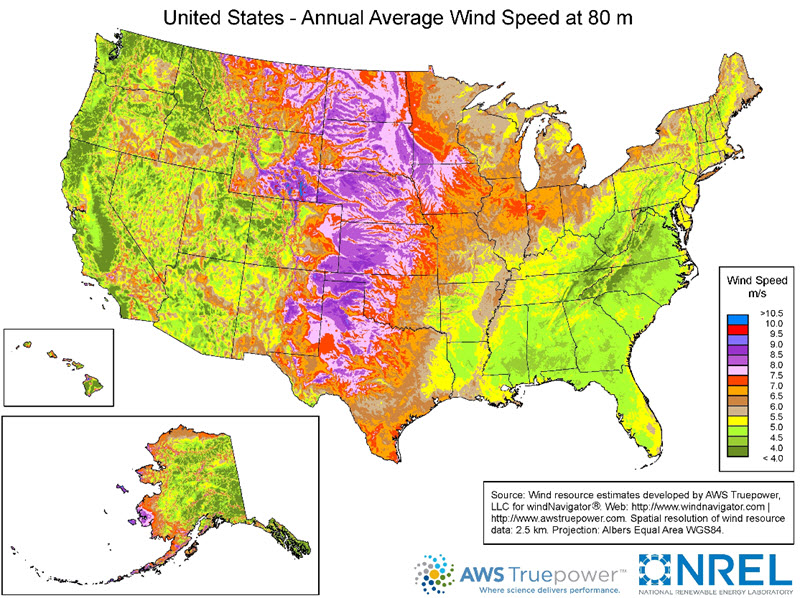
Map: NREL/AWS Truepower — US Annual Average Wind Speed at 80m. Windra operates at 1,000–10,000 ft where winds are significantly stronger and more consistent than surface measurements.
Years of prototyping. Wind tunnel testing. Advanced computational tools. A patented system. Here's the simple version.
The technology is protected by a US utility patent covering the full system — from the floating module and turbine configuration to the tethered power transfer and AI ground control.
*LCOE = Levelized Cost of Energy — the standard measure of the long-term cost to produce electricity.
Each unit produces more than 100 kWh per day. Scale is built in — add more units, multiply the power.
Enough to power 3–4 US single-family homes, or a small farm — continuously, day and night, regardless of weather.
Ten units together power an entire rural community, a large commercial farm, or an off-grid industrial operation.
A full-scale airborne wind farm delivers utility-scale power anywhere on Earth — no transmission corridors needed.
The world needs fundamentally new ways to generate clean energy. Windra opens a resource that has never been harvested — and the system to do it is ready.
The US Department of Energy projects renewables growing to 25% of electricity by 2035. High-altitude wind is the most consistent, least contested source in that mix — and essentially no one is harvesting it yet.
A US utility patent covers the full system — the floating module, turbine configuration, tethered power transfer, and AI control. Multiple years of deep engineering and rigorous testing back it up.
Working prototypes have flown. Real power has been generated. Performance has been measured. This isn't a slide deck — watch the demo video and see for yourself.
Target Levelized Cost of Energy (LCOE) of $25/MWh — well below ground wind and most solar. No land to buy. Minimal civil infrastructure. The economics work at every scale.
Full system designed, tested, and patent filed. Eight design generations refined through hands-on development.
Live flight demonstrations completed. Real electricity generated. System performance validated under real-world conditions.
Grid-connected testing underway. Measuring performance across altitudes, wind conditions, and weather patterns.
Pilot partnerships with utilities, rural communities, and farms. Scaling up to full airborne wind farms and long-term energy contracts.
No new transmission lines. No land battles. No turbines blocking the horizon. Just clean power, delivered to the people who need it most.
The system floats above your land. Farms stay farms. Forests stay forests. Nothing below is displaced or disrupted.
Operates far above bird and bat flight paths. Designed from the ground up with minimal ecological impact — not retrofitted as an afterthought.
Connects directly to local microgrids. Rural communities don't need to wait for utility upgrades or transmission decisions that may never come.
High-altitude operation means zero visual impact on landscapes or viewsheds. Clean energy that's truly invisible from the ground.
One unit generates more than 100 kWh per day — enough for a family home, a small farm, or a rural small business, around the clock.
Tethered microgrids keep communities powered during outages. The system adjusts altitude automatically to handle severe weather.
“Like a kite that powers your farm. It floats above, harvests the wind that's always blowing strong up there, and sends clean electricity right down — without touching a single acre of your field.”
Whether you're an investor, a rural community leader, or a homeowner ready for something different — we want to hear from you.